
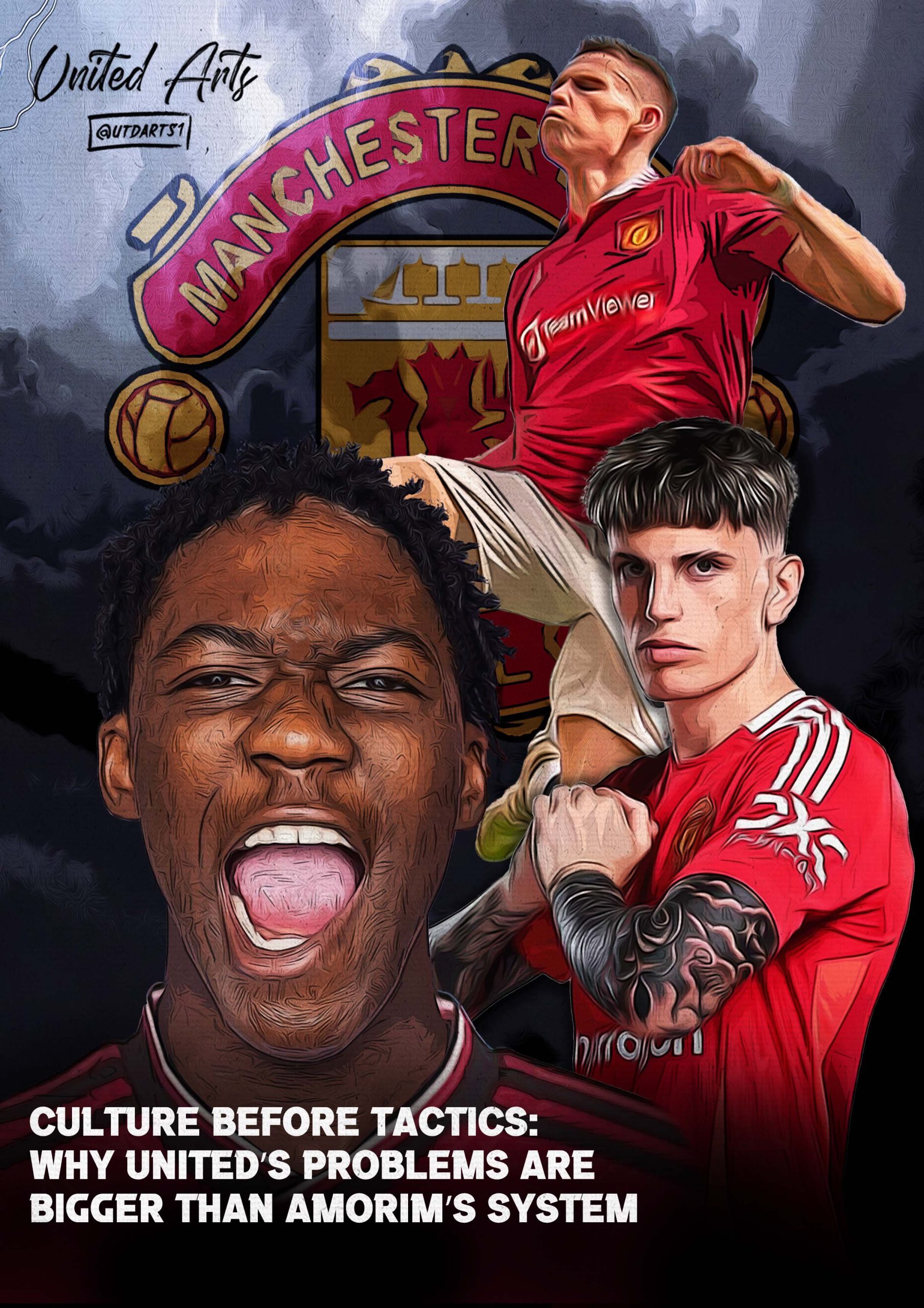
Recent struggles with promising talents at Manchester United, such as Alejandro Garnacho’s attitude problems and Kobbie Mainoo’s poorly timed loan request, highlight a fundamental truth: no tactical system, however brilliant, can succeed without the proper cultural foundations.
While fans desperately want immediate tactical solutions, every successful club rebuild of the past decade proves the same uncomfortable reality: culture must come first, tactics follow.
This isn’t about blind patience, but recognising that lasting success requires following this specific order, while quick tactical fixes inevitably fail.
Understanding the true sequence of change at Manchester United
When a football club finds itself in crisis, the instinctive reaction is to demand immediate tactical revolution. We obsess over formations, pressing, and build-up patterns, expecting these surface-level adjustments to transform our fortunes overnight.
But this approach fundamentally misunderstands how successful rebuilds actually work. The uncomfortable truth is that tactical excellence cannot precede cultural transformation.
The sale of Garnacho to Chelsea perfectly illustrates this reality. Here was one of our academy’s most promising talents, a player who had scored crucial goals, lit up Old Trafford with his flair, and represented everything exciting about United’s future. Yet the club felt compelled to sell him due to attitude problems that had reportedly become untenable behind the scenes.
This wasn’t a football decision; it was an admission of institutional failure. Under Sir Alex Ferguson, a player with Garnacho’s talent but questionable attitude would have faced the manager’s office, stern words, and a clear ultimatum: change or leave.
But crucially, Sir Alex would have first invested time in trying to save the player. He had the luxury of knowing he’d be there next season and the season after. He had owners who backed his long-term vision and a club structure that understood cultural development takes time.
Sir Alex famously rehabilitated complex characters like Eric Cantona and Roy Keane, whose aggression often crossed lines. These weren’t just tactical decisions; they were cultural investments that paid dividends for years. But such rehabilitation requires what United currently lacks: managerial security, institutional patience, and a clear vision of what the club stands for.
At today’s United, with six permanent and interim managers in four years and constant speculation about the next appointment, no manager has the security to undertake such cultural rehabilitation. Why would Amorim spend months working on Garnacho’s attitude when his own future remains uncertain?
The result is that promising talents with correctable flaws become unsalvageable problems, shipped out to rivals who may well succeed where we failed.
Manchester United’s Cultural Breakdown
The collapse after Sir Alex left shows a brutal truth: once a winning culture dies, no tactical system can save you. Fergie’s winning culture was replaced with a culture of greed, mirroring the Glazers’ image. When you recruit players for money rather than glory, you won’t get the best out of them.
The Mainoo situation exemplifies this breakdown. Despite being told he was essential to the club’s plans and having started against Grimsby just days earlier, Mainoo requested a loan move with four days left in the transfer window. This isn’t about his England ambitions, it’s about a young player who doesn’t feel the cultural pull to fight for his place at United.
This pattern repeats with devastating regularity. People constantly ask, “Why players fail at United but immediately thrive elsewhere?”. The answer isn’t mysterious; it lies in the toxic environment we’ve cultivated over the past 12 years, where Sir Alex’s winning culture was systematically replaced by the Glazers’ culture of greed and short-term thinking.
Scott McTominay provides a poignant example of this dysfunction. Here was a player with everything you’d want: fantastic character, genuine love for the club, and the versatility to play multiple positions. Yet he became a symbol of United’s decline not through any failing of his own, but because the structural chaos of the club wasted his talents.
McTominay was constantly deployed out of position, sometimes as a number 10, sometimes as a centre-back, occasionally as a defensive midfielder, not because these were his best roles, but because we lacked proper squad planning. We had no identity, no clear tactical system, so we asked him to plug whatever hole appeared that week. Being the loyal clubman he was, he obliged without complaint. He became the Swiss Army knife solution to our deeper problems.
The cruel irony is that this versatility, born from necessity, became a stick to beat him with. Fans criticised him for not being a specialist, for lacking a defined role. But how could he develop specialist skills when every manager used him differently? How could he master a position when the team’s tactical identity changed every 18 months?
Meanwhile, McTominay absorbed criticism that should have been directed at the system that failed him. He never threw teammates under the bus, never publicly complained about his treatment, and never agitated for a move despite being scapegoated by frustrated supporters. His professionalism was exemplary in an environment that had forgotten what professionalism looked like.
Now at Napoli, within Conte’s structured system and clear tactical framework, the Scot is thriving. He knows his role, understands his responsibilities, and plays in a team with a genuine identity. The contrast is stark and damning. United didn’t lack talent; we lacked the culture and structure to develop that talent properly.
Each post-Sir Alex manager diagnosed aspects of the cultural problem, yet none received sufficient time or institutional support to address root causes. Instead, tactical underperformance led to their dismissal, perpetuating the cycle without addressing foundational issues.
How elite clubs sustain excellence
Real Madrid’s sustained excellence across different managers stems from an uncompromising culture where winning is demanded at every level. Players arriving immediately understand: excuses don’t exist; only standards do. This explains their seamless transitions between tactically different managers.
Bayern Munich’s “Mia san mia” philosophy transcends specific tactical approaches. This cultural bedrock enables transitions between diverse managers while maintaining competitive standards. When Bayern identifies a decline, they address cultural standards before tactical adjustments.
Ajax’s “For the future” motto reflects a culture where individual components serve collective continuity. Their developmental philosophy views players as absorbing cultural values before undergoing tactical refinement, a sequence that cannot be reversed.
The Liverpool blueprint
Jurgen Klopp’s transformation of Liverpool offers the clearest example of cultural reconstruction preceding tactical mastery. When he arrived in October 2015, Liverpool were mired in mediocrity following years of disjointed thinking, not entirely unlike United’s current predicament.
Klopp’s first press conference set the tone: “We need to change from doubters to believers.” This wasn’t tactical jargon but cultural reframing. His initial months weren’t characterised by tactical perfection. His early Liverpool sides were often chaotic and inconsistent. His focus remained on changing mindsets and establishing non-negotiable standards.
What’s often forgotten is Klopp’s restraint in his first transfer window. Only modest signings of Marko Grujic and Steven Caulker arrived, demonstrating his understanding that recruitment without a cultural foundation merely perpetuates dysfunction.
During those first 18 months, Klopp embedded cultural pillars: resilience, collective responsibility, and an uncompromising work ethic. Only once these foundations were solid did Liverpool’s tactical identity truly crystallise. The sophisticated machine that eventually conquered Europe emerged organically from cultural foundations laid over multiple seasons.
Amorim’s monumental challenge
When Ruben Amorim speaks about “changing things,” he’s calling out the acceptance of mediocrity at United that no formation can overcome. At Sporting, he inherited stronger cultural foundations despite recent turbulence. At United, the cultural erosion runs deeper and has persisted longer.
The Garnacho and Mainoo situations represent the scale of this challenge. Both are academy products shaped by the toxic culture developed over the past decade. Their problems aren’t individual failings; they’re symptoms of an environment that has failed to instil the values necessary for collective success.
Amorim’s task isn’t merely tactical implementation but cultural reconstruction. This cannot be rushed, regardless of external pressures.
Measuring real progress
How should supporters measure progress during the rebuilding process? The answer lies in observable patterns beyond results: response to adversity, collective responsibility, consistent intensity, and visible accountability. These cultural indicators often emerge before results improve.
For United, progress might manifest in reduced collapses after conceding, increased pressing intensity, and, more importantly, young players choosing to fight for their place rather than seeking easy exits.
The price of ignoring culture
The recent departures might represent necessary surgery. If players aren’t willing to buy into the required cultural transformation, prioritising individual advancement over collective struggle, perhaps it’s better for them to leave now rather than undermine the rebuilding effort.
Ineos must provide consistent support for cultural reconstruction, even when short-term results are disappointing. The post-Sir Alex era demonstrates the futility of abandoning cultural projects due to tactical underperformance. This cycle must be broken.
Manchester United’s rehabilitation will proceed at the pace cultural transformation allows, not faster. Cultural foundations must be established before tactical sophistication can emerge. This sequence has defined every successful rebuild in European football.
Culture before tactics, always. The price of ignoring this truth is another decade of decline. The reward for embracing it is sustainable success built on foundations that can weather any storm.
Let us know your thoughts in the comments or across our social channels. You can contact Reza through Twitter or his website.
Recent Posts
- Theatre of Red podcast | Episode 86 | Carrick endures his first setback

- Ten-man Newcastle hand Michael Carrick first defeat at Manchester United

- Manchester United to embrace a challenging trip to St James’ Park

2 responses to “Culture Before Tactics for Manchester United and Ruben Amorim”
Brilliant analysis and spot on…👌🇾🇪
Thank you for getting in touch, Fran. We agree. Reza did a great job.